Sydea’s Severance from the System
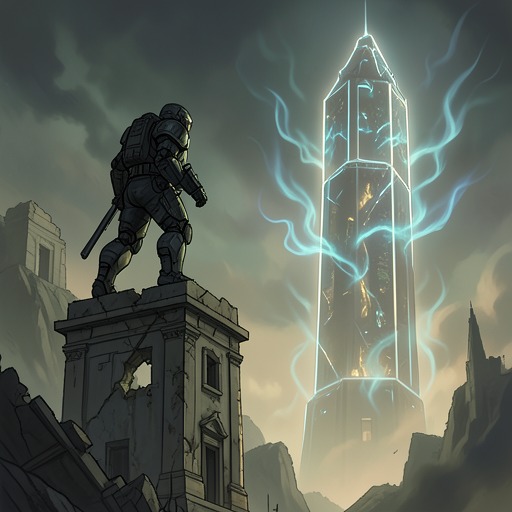
Systema Delenda EstSydea’s Severance from the System is the decisive planetary rupture in which Cato removes Sydea from the System’s control and exposes the hidden cost of that freedom. What appears politically as the defeat of a divine order becomes materially a planetary emergency: essence disappears, towns lose power, mountains and lakes fail, alien ecosystems die, and the inhabitants must learn to survive in a world no longer sustained by the rules they had mistaken for nature.
Causes and Background
Cato’s campaign against Sydea targets the System’s anchors rather than its population. After extracting the System Interface from the gem in Onswa’s office, his mindripper software produces a workable emulation of the intelligence contained there. The process is not yet true digitization, but it is sufficient for Cato to destroy the city anchor. The remaining System towns are then targeted because they are easier to locate than any conventional capital. The last anchor is the System-God associated with Sydea, who has already abandoned it, leaving the planetary Nexus exposed.
The event is part of Cato’s larger strategy against the System rather than a campaign against Sydea’s people. He repeatedly distinguishes his grievance with the System from hostility toward its inhabitants. That distinction becomes politically important after the severance, because the people experience Cato’s liberation as catastrophe even though it leaves them alive. The event therefore turns a conflict over sovereignty into a conflict over the conditions of existence itself.
The Collapse of Sydea
Once the planetary Nexus is removed, every other town appears to lose power, or more precisely, essence: the System’s universal resource and operating medium. Lights go out and stores shut down as the System retreats. Ordinary physics, native biology, and unregulated ecology begin spreading into spaces that had been artificially maintained. The scale of System dependence becomes visible through sudden geological failures. Mountains crumble or vanish, and broad lakes become muddy plains as the planet’s prior configuration gives way.
The transition is not orderly. Storms arise without warning and disappear just as abruptly, creating a final burst of atmospheric chaos. Grasslands shift toward native life while alien forests wither. Sydea does not simply return to its pre-System condition: transplanted organisms in many regions die rather than vanish, leaving enormous scars that will persist for years or decades. Cato has already begun preparing biological factories, but those factories cannot prevent the immediate consequences of the severance.
The event also reveals how thoroughly the System had replaced the planet’s natural processes. Its disappearance threatens not only settlements and visible infrastructure but the ecological foundations of life, including the biological systems responsible for producing oxygen. The later planning for the collapse of other worlds treats total ecosystem failure as a likely outcome, with oceans, atmospheric chemistry, microorganisms, and food production all requiring deliberate remediation. Sydea is thus both a liberation and an unplanned experiment in separating a world from the artificial order that had governed it.
Reactions and Religious Consequences
The severance destabilizes more than landscapes. Muar, who has experienced a System-less space, remembers it as a blank, silent void without status, guidance, or intelligible progress. When he reaches a temple on Uriva, the building’s System crystal and its ritual atmosphere soothe him, and meditation there earns him the Divine Insight Skill. His reaction establishes the emotional and religious counterpoint to Cato’s project: for Muar, the System is not merely an administrative structure but the source of truth, purpose, and meaning.
Initik’s later unease shows how Sydea’s disappearance continues to reverberate among the gods. Months after Sydea vanishes from the System, he remains troubled despite no visible disturbance on Uriva and no change in the Sydean body held in stasis. When Muar reports seeing Raine and Leese Talis, whom Initik personally witnessed die on Sydea, the disappearance becomes evidence that Cato’s conflict is not finished. Initik suspects that the versions destroyed by Cato may have been copies, but his divine perception had identified them as genuine Copper-ranked individuals. Their apparent survival therefore confirms that Cato operates outside the System’s normal rules.
The event also changes the political calculations of the System’s ruling powers. Marus Eln, the former World Deity of Sydea, escapes with a large quantity of essence and a recording of what Cato accomplished. The recording helps persuade his superiors that Sydea is a lost cause, although Marus believes his treatment is softened chiefly because Clan Lundt has also lost a world. He is reduced to a comfortable but insignificant post on an inner world, where he administers routine quests and manages conflicts among lower-ranked clan scions. Sydea’s fall consequently becomes a liability that its former administrator must explain and a precedent that other powers fear.
Wider Systemic Consequences
Sydea’s severance proves that the System can be removed from an inhabited world, but it also gives Cato a model for expansion. The event is followed by a period in which exponential growth appears deceptively slow: Cato hides in a lunar crater with only a few drones, a rudimentary solar array, and a hacked-together manufactory. From silicon, carbon, and lighter elements, the manufactory produces what it can, while the scarcity of proper metals limits the pace of development. This small beginning later becomes the industrial foundation of a force spread across hundreds of worlds.
Years of industrialization turn the lesson of Sydea into a scalable campaign. Cato establishes mines, factories, refineries, solar-panel production, and facilities capable of extracting resources from gas giants and icy asteroids. Each world develops its own armies and warframes, compensating for the inability to move military forces efficiently through the portals. The severance is therefore not an isolated victory: it is the first clear demonstration that System-supported worlds can be detached, after which Cato builds the material capacity to repeat the process on a much larger scale.
The System’s defenders eventually recognize the extent of that expansion. Muar discovers that Cato’s forces have reached every Inner World, with artificial structures breeding his creations beyond the System’s immediate reach. What had seemed like scattered opportunism is revealed as a disease that has spread through both the frontier and the politically protected Inner Worlds. Those worlds cannot be purged as expendable frontier holdings, because their value makes destruction unacceptable and because admitting their compromise would undermine official assurances that Cato was close to defeat.
Legacy and Narrative Significance
Sydea’s Severance establishes the central paradox of Cato’s war: destroying the System may be necessary for freedom, but the System has become so deeply embedded in reality that liberation initially resembles apocalypse. Its collapse removes imposed physics and divine administration while also threatening oxygen, food, geology, weather, biodiversity, and social order. The inhabitants are not liberated into a ready-made alternative; they are forced into the unfinished work of reconstruction.
That burden remains visible on Heyk, where a later System collapse produces massive plant die-offs, falling oxygen levels, and dead alien biomatter that native bacteria cannot decompose. Cato must coordinate remediation while inhabitants, unprepared for life outside the System, even attempt to burn grain crops instead of growing food. The same pattern gives Sydea’s disappearance its lasting importance: it is the first planetary-scale proof that the System’s withdrawal is both a political emancipation and an ecological rupture.
The event also supplies the book’s most consequential contrast between faith and autonomy. Muar experiences System-less existence as meaningless emptiness, while Cato treats the System as an enemy whose removal is worth the danger. Neither response is presented as a simple abstraction. One is embodied in temple ritual, meditation, divine Skills, and the relief of returning to System space; the other is embodied in anchors destroyed, factories built, worlds severed, and biological systems reconstructed. Sydea’s fall makes the disagreement concrete, forcing every later liberation to confront the question of whether a world can survive after the order that made it recognizable has gone.